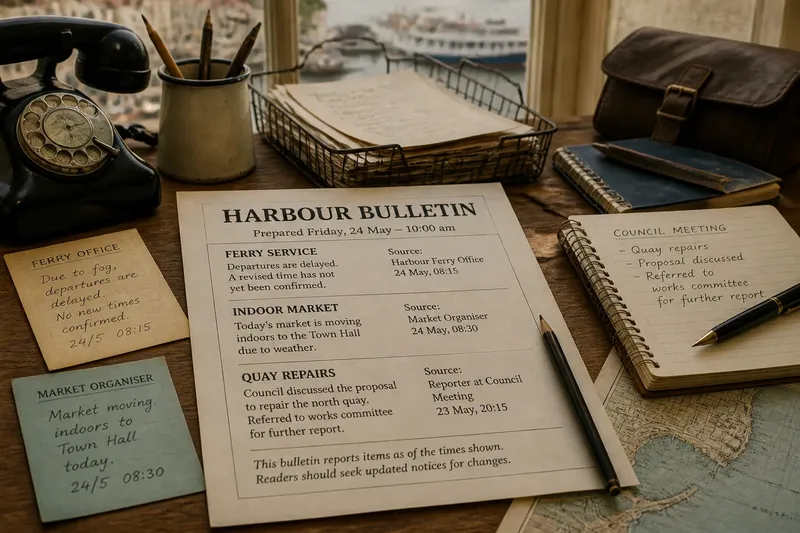
Attribution: The Small Phrase That Tells You Who Is Making a Claim
Attribution in news reporting shows who stands behind a claim, so you can separate a source’s account from facts the newsroom has established.

Attribution in news reporting can turn a sentence from an apparent fact into a clearly reported claim. “The bridge is unsafe” sounds like the newsroom has established a condition; “the council engineer says the bridge is unsafe” identifies who is making that judgement. Those few words tell you where the statement comes from—and where responsibility for it sits.
Read attribution as a map of claims, not a decorative tag. These six checks help you follow that map through a report, even when the wording is brief or the source is not named.
1. Find the speaker attached to each claim
Start by asking who is responsible for the statement in the sentence you are reading. The answer may appear before the claim (“the union said”), after it (“…according to the police”), or in a phrase that identifies a document, witness or institution.
Then make sure the attribution belongs to the claim you think it does. A report can open with a named speaker and move into several sentences of background. The original attribution may continue to govern the next sentence, but it does not automatically cover every claim that follows. Watch for a fresh subject, a new paragraph or a change in tense that signals a different source.
Consider this invented situation: a local report says, “The market will close on Friday, the manager said. Traders are seeking new pitches.” The first sentence attributes a closure date to the manager. The second gives no source for the traders’ action; unless the report supplies one elsewhere, do not assume the manager is its source as well.
Attribution is a little like a name written on a storage box: it tells you who put the contents there, but it does not certify everything inside. Keep the speaker attached to the particular claim, and you are less likely to let a source’s assertion become the report’s own voice.
2. Separate a source’s account from a reported fact
A story can contain both a claim made by a source and a fact the newsroom says it has established. Attribution is one of the main clues to the distinction, but grammar matters too. “The minister said the figures were complete” reports what the minister said. It does not, by itself, establish that the figures were complete.
Compare that with “The published table includes entries for every district; the minister said it was complete.” The first clause describes something a reader could check in the table. The second reports the minister’s interpretation. The two statements may support one another, but they are not the same kind of evidence.
Look for what the report presents as its own account: a document it has examined, an event its journalists witnessed, or a detail confirmed through named records or other sources. A newsroom’s assertion is not automatically beyond question, but it differs from a source’s attributed statement. Good reporting makes that boundary visible instead of quietly blending the two.
This distinction is especially useful with claims about cause, intention or responsibility. A person may say a service failed because of a shortage, or that an opponent intended a particular outcome. Those explanations remain the speaker’s account unless the report separately substantiates them. Ask not only, “Who said this?” but also, “What does the report show for itself?”
3. Notice whether the source is named, described or withheld
A named source lets you assess a claim with more context. A report might identify a school governor, a laboratory director or a resident who witnessed an incident. A description such as “a council spokesperson” gives less personal detail but still identifies a role. An anonymous source gives readers less to inspect, so the wording around that source deserves particular attention.
Anonymity may protect someone from retaliation or allow information to be reported when a source cannot speak publicly. It can also make it harder for readers to judge the source’s access, interests and reliability. Look for an explanation of why the identity is withheld and what the report says about the person’s connection to the matter.
Distinguish direct knowledge from second-hand accounts. “A resident who was at the meeting said…” claims a particular kind of access. “A person familiar with the discussion said…” leaves the access less precise. Neither phrase proves the claim; each tells you how the newsroom characterises the source’s position.
Do not treat a confident description as a substitute for a name, or anonymity as automatic evidence that a report is false. Instead, note what is disclosed, what remains obscured and whether the article gives independent support. The source’s status is part of the evidence picture, not a verdict on its own.
4. Read the verbs for the kind of claim being made
Attribution verbs carry meaning. “Said” usually reports speech without telling you whether the newsroom agrees. “Alleged” marks an accusation that has not been established in the wording. “Confirmed” suggests verification, so check who is doing the confirming and what exactly they confirmed. “Admitted” implies a concession; “insisted” can signal disagreement or emphasis.
These choices can shape the reader’s impression before the details arrive. Two sources may make comparable statements, yet one is said to “explain” while the other “claims”. That contrast may be justified by their evidence or by the surrounding facts, but it is worth noticing. Ask whether the verb accurately describes the source’s act, or quietly invites you to trust or distrust that source.
Also separate a source’s words from a reporter’s characterisation. “The company denied that the leak posed a risk” reports a response. “The company dismissed the risk” may describe the tone or substance of that response, but it is not necessarily a quotation. Quotation marks should signal exact wording; paraphrase should preserve the point without pretending to reproduce the speaker’s precise language.
A useful reading habit is to mentally replace a loaded verb with “said” and see whether the sentence’s evidence changes. If it does, the stronger verb is doing interpretive work. That is not automatically wrong, but the report should give enough context for you to understand why it fits.
5. Check the boundaries of quotations and paraphrases
Quotation marks show that a report is presenting words as a source’s own. They do not show that the words are true, representative or complete. A short quotation may accurately reproduce a phrase while omitting the qualification that came immediately before or after it.
Read the sentence around a quote, not just the vivid fragment. Does the report identify who spoke and in what setting? Does the surrounding text explain whether the speaker was answering a question, describing a personal experience or making a broader claim? Context can change what a quotation reasonably supports.
Paraphrase works differently. It gives the substance of what a source communicated in the reporter’s wording. That can make a report easier to read, but it also means you cannot inspect the exact phrasing. Look for clear attribution and take care not to treat a paraphrase as a verbatim quotation.
When a quote contains a factual assertion, ask whether the report leaves it as a claim or adds independent support. “The water smelled of chemicals,” a resident said, conveys the resident’s perception. It does not identify a substance or establish a cause. A report might separately describe a water authority’s test results, but those results are a different source of information and should be attributed on their own terms.
6. Compare sources without mistaking repetition for confirmation
Several outlets or officials repeating the same claim can look like several confirmations. Trace the chain: did each source observe the event or examine the underlying material, or are they all relaying one original account? A statement repeated from a press release remains dependent on that press release unless someone independently checks it.
Within one report, multiple sources can still be useful when they bring different access or expertise. A transport agency may describe its decision, a passenger may recount what happened during a journey, and a specialist may explain the technical issue. Their accounts address different parts of the story; one does not automatically verify every claim made by another.
Notice when a source has a clear stake in the outcome. A company, campaign group, public authority or claimant may have relevant knowledge and an interest in how the story is understood. Attribution lets the report include that account without disguising its origin. The next question is what evidence accompanies it and whether other relevant perspectives are represented.
“Both sides say” can also conceal the difference between a documented fact and a disputed interpretation. Do not count voices as if a larger number settles the issue. Ask what each source can know, which claims are independently supported, and whether the report explains unresolved disagreement.
7. Use attribution to follow uncertainty across a story
Reports often contain information at different stages of certainty. An authority may announce an investigation; a witness may describe what they saw; a spokesperson may offer an explanation; later reporting may establish details from records. Attribution helps you keep these layers separate as the account develops.
Pay attention to changes in wording between updates. “The agency said it was examining the cause” is not the same as “the agency identified the cause”. Likewise, an early estimate attributed to an official should not be read as a settled finding merely because it appears in a polished article. Look for whether the report marks a statement as preliminary and whether later evidence changes the account.
If an article says “according to documents”, ask what documents are meant and what they actually establish. A schedule may show that a meeting was planned, not that it happened. A complaint may show that an accusation was filed, not that it was upheld. Naming the source type is helpful, but the scope of the source matters just as much.
Attribution in news reporting is most useful when you follow both the speaker and the limits of the speaker’s knowledge. Keep the claim, its source and the report’s supporting evidence distinct in your mind. That small pause makes it easier to recognise what is known, what is alleged and what remains open.
What should you ask when attribution is unclear?
Does “according to officials” identify a source?
It identifies a broad category, not a particular person or office. Check whether the report explains which officials, how many, and what access they have to the matter.
Does a named expert’s opinion make a claim a fact?
No. A named expert can help readers judge a source’s relevant knowledge, but an opinion or prediction remains an attributed assessment. Look for the evidence or reasoning offered alongside it.
Why does a report use an anonymous source?
The source may face a risk from speaking publicly, or may have access to information that cannot otherwise be reported. Look for the newsroom’s explanation and for corroboration that does not depend solely on the hidden identity.
What if an attribution appears only once?
Check whether the following sentences clearly continue the same account or introduce a new claim. If the boundary is uncertain, treat the later statement cautiously rather than assigning it to a source by assumption.