The Headline Shortcut: When a Question Starts to Sound Like a Claim
Question-shaped headlines can hint at an answer before you read the story. Learn to separate their framing from the evidence in the reporting.
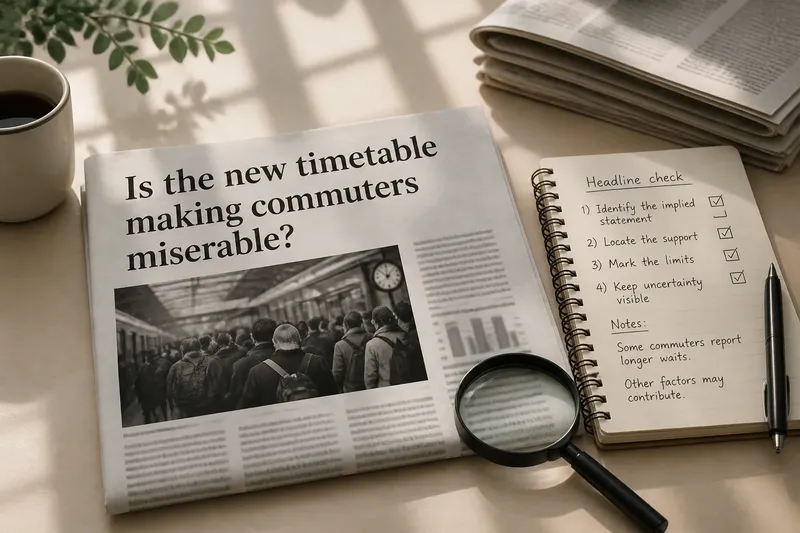
A question-shaped headline can leave a claim in your mind even when it never states that claim. “Is the new timetable making commuters miserable?” asks about a possibility; it does not establish that the timetable caused anyone’s frustration. But the wording has already linked the two, so a reader may carry away the implication rather than the question.
That shortcut is the subject of question-shaped headlines: how their framing nudges interpretation, and how to distinguish that nudge from what the story actually supports. The useful move is not to dismiss every headline framed as a question. It is to hold the question open long enough to check who is asking it, what evidence follows, and whether the article answers it at all.
Question-shaped headlines put a proposition inside a question
A direct headline makes an assertion: “The new timetable has increased commuter delays.” A question headline can point towards a similar proposition without taking responsibility for stating it: “Has the new timetable increased commuter delays?” The second is grammatically a request for an answer, not a factual finding.
Yet questions are not neutral containers. They select a subject, imply a possible connection and invite the reader to consider a particular answer. A headline asking whether a mayor’s decision “is driving residents away” makes that causal link salient, even before the article establishes whether residents are leaving, what they say about it, or what other factors might matter.
Think of the question as a spotlight rather than a verdict. It illuminates one possible angle, but the beam does not prove what lies in it. That distinction matters because headlines are often encountered alone: in a search result, a social post or a crowded news feed, without the paragraphs that might qualify them.
The wording can imply more than the grammar asserts
Some questions are open invitations: “What will the council’s revised plan change?” Others smuggle in an expectation: “Why is the council’s revised plan failing?” The word “why” presumes failure; the question asks for an explanation of something it has already treated as true.
Other cues work more quietly. A headline may pair a troubling outcome with a recent policy, use a loaded adjective, or place two events side by side so that one appears to explain the other. “Could the new school rule be harming pupils?” does not assert harm, but “harming” gives the possibility an emotional shape and makes the rule the leading suspect.
There is no single word that makes a question unfair. “Could”, “does” and “why” each depend on the proposition they introduce and the reporting beneath them. The practical question is whether the headline’s implied premise is established in the story, merely investigated, or left hanging.
Separate the headline’s frame from the article’s evidence
Read the headline once, then turn its question into a plain statement. “Is the new bus lane worsening traffic?” becomes “The new bus lane may be worsening traffic.” This rewrite makes the implied proposition easier to inspect. It also prevents the headline’s question mark from disguising how much the reader is being asked to assume.
Then look for the article’s answer, not simply for a sentence that resembles the headline. Check what the reporting establishes, what it attributes to a source, and what remains uncertain. A quoted resident’s view can document that resident’s experience; it does not by itself establish a city-wide pattern. An official’s explanation is evidence of what the official says, not automatic confirmation that the explanation is correct.
Pay particular attention to the relationship between events. If the story reports that a change happened before an outcome, that sequence alone does not show the change caused the outcome. Look for reporting that addresses other plausible explanations and makes clear what can and cannot be inferred. If the article supplies no basis for the headline’s suggested link, the implication belongs to the framing, not to a demonstrated conclusion.
Imagine you see “Is the library’s new booking system shutting out older readers?” The story reports that a few readers found online reservations confusing, while the library offers bookings by phone and at the desk; it provides no broader account of who can access the service. You can reasonably conclude that some readers described difficulty, but not that older readers as a group are being shut out. The headline raises a concern; the evidence sets its boundaries.
Check the question’s premise before accepting its answer
A useful reading pass has three distinct checks:
- Identify the implied statement. Rewrite the question as a plain claim, including any suggested cause or consequence.
- Locate the support. Find the article’s reporting for each part of that claim, rather than relying on a matching phrase in the headline.
- Mark the limits. Note whether the support comes from one person, a document, direct observation or a broader set of evidence, and what the story does not establish.
- Keep uncertainty visible. If the article offers possibilities rather than an answer, retain that uncertainty when describing the story to someone else.
These checks help distinguish a question that genuinely opens an inquiry from one that quietly presumes its most important point. They also stop a reader from treating a lively headline as a compact version of the article’s findings.
Question headlines can serve different editorial purposes
A question may be a fair way to frame an unresolved issue. Reporting might explain that evidence is incomplete, that experts disagree about a forecast, or that a decision’s effects are still emerging. In such cases, the headline can signal that the article examines a live question rather than announces a settled answer.
Questions can also make a complicated subject approachable. “What changes under the revised tenancy rules?” tells readers the story will explain a set of provisions. That is different from “Will the revised rules leave tenants homeless?”, which raises a specific and serious consequence. The latter calls for reporting that treats the possibility with care, not merely a dramatic opening anecdote.
Sometimes the article answers a question only in a limited sense. It may find that a policy has affected one neighbourhood but cannot establish the same effect elsewhere. A careful headline and story should make that scope legible. As a reader, keep the answer at the scale the reporting supports: a local observation should not quietly become a claim about everyone.
Questions readers ask about headline framing?
Does a question mark make a headline legally or journalistically safe?
No. A question mark changes the sentence’s form, but it does not remove the implication readers may take from its premise. Judge the framing alongside the article’s evidence and the impression the wording creates.
Can a question headline still be accurate?
Yes, if it fairly describes the issue the story investigates and does not present an unsupported premise as settled. The article should make clear what is known, what is contested and whether it reaches an answer.
What if the story never answers its headline question?
That can signal an open-ended report, but it can also leave the headline’s suggestion doing work the reporting has not done. Separate the documented facts from the unresolved question, and avoid repeating the implication as a finding.
Should I ignore question-shaped headlines?
No. Treat them as a prompt to inspect the frame, not as evidence either for or against the claim. The reporting may support the suggestion, complicate it or leave it unanswered.
Repeat the evidence, not the insinuation
When discussing a story, phrase your account around what the article actually establishes. “The report describes complaints about the booking system” is more precise than “The system is shutting older readers out” if the story has not shown that broader effect. If the article’s answer is uncertain, say so plainly.
This habit is especially useful when a headline travels farther than its article. A question can be copied, quoted or remembered as though it were an answer, particularly when its suggested claim is alarming or neatly confirms what a reader already suspects. Before passing it on, ask whether you are sharing the reported evidence or only the possibility the headline placed in view.
The headline’s question is a starting point for reading, not a substitute for the story’s case. Keep its implied claim separate from the evidence, and you can remain curious about the issue without letting the question answer itself.