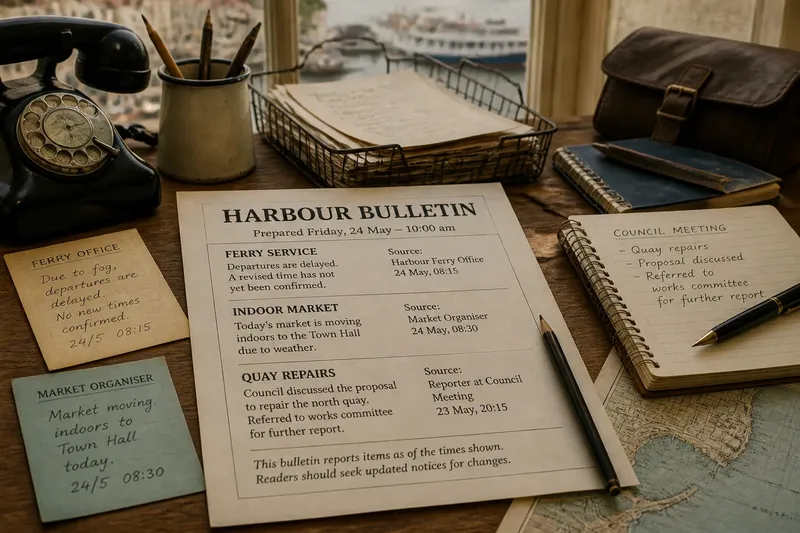
One Ongoing Story, Read in Three Passes
Read an evolving news story in three passes to separate its latest development from earlier reporting and see clearly what remains unresolved.
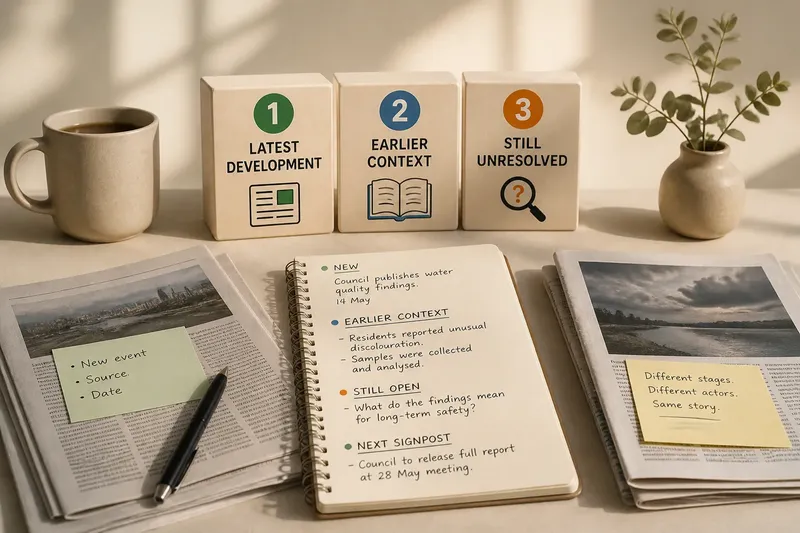
An evolving news story is easier to follow when you read it in three passes: identify the latest development, revisit the earlier account, then note what is still unresolved. That routine keeps a fresh update from quietly replacing the context that made the story matter in the first place.
It is especially useful when a story changes in small, uneven bursts: a hearing ends, an agency responds, a count is revised, or a promised report is delayed. You do not need to read every update as it appears. Instead, set aside a short, regular moment to distinguish what has changed from what has merely been repeated.
Start each reading session with the newest development
Begin with the latest report from a publication you trust to identify what happened, and when. Look beyond the timestamp on the page: an article may have been refreshed recently while describing an event from earlier, or it may contain a new paragraph attached to an older account.
Find the specific event or decision that prompted the update. Is there a new document, a public statement, a completed vote, a confirmed result, or simply a response to an earlier report? Write a plain sentence in your own words. For instance: “The committee postponed its decision today.” Keep this sentence narrow. Avoid adding a reason unless the reporting establishes one.
Then check whether the article distinguishes a confirmed development from a proposal, prediction or claim. A plan can be announced without being approved; an official can describe an event without resolving what happened. These distinctions are not fine print. They determine what the update actually changes.
If several outlets cover the same development, compare their descriptions of the event rather than counting headlines. A report that says a review has begun and one that says officials are considering a review may refer to different stages. Notice the verb, the actor and the timing. Those small choices often reveal whether the story has advanced or the framing has shifted.
Revisit the earlier account before drawing a new conclusion
Once you have named the latest event, return to an earlier report that explains the story’s starting point. It might be the first substantial article you read, a timeline maintained by a newsroom, or a previous update that laid out the central question. The aim is not to reread everything. It is to recover the baseline against which this new development can be judged.
Ask what was known then, what was attributed to a source, and what remained uncertain. Separate the event itself from the explanations offered for it. If a report said a decision was expected after a review, for example, the expectation was not the decision. Remembering that difference stops an old forecast from masquerading as a new fact.
Look for changes in the story’s scope. A report may now concern a different agency, a wider group of people, or a later stage of a process. If the subject has shifted, note that openly rather than treating every article as another chapter in one unchanged account. Continuity is useful, but it should not flatten meaningful changes.
Say you have been following a local water-quality investigation. The first account says residents reported unusual discolouration and that samples were being analysed; a later update says the council has published its findings. In this invented situation, you would first record the publication of the findings, then revisit the earlier account to recall which samples and concerns it covered. The expected observable result is a clearer comparison between the question originally raised and the evidence now reported, without assuming the findings settle every concern.
Keep a short record of what changed and what did not
A few lines of notes can preserve context better than a stack of open tabs. Use a notebook, a plain text file or a document with three simple labels: “New”, “Earlier context” and “Still open”. Add only points that help you understand the movement of the story.
- New: Record the latest event and its date, using a restrained description.
- Earlier context: Note the original question, decision or event that brought the story into view.
- Changed: Identify whether the new report alters a known fact, a timetable, the scope or only the available explanation.
- Still open: Write down the unanswered question without turning it into an assumption.
- Next signpost: Note what could clarify matters, such as a published document, a scheduled meeting or a response from another party.
This is a record for your own understanding, not a verdict on the reporting. Keep claims attached to their source in your notes: “The department says…” is more precise than silently converting its statement into an established fact. If you return to the story later, that small distinction helps you remember what the article reported and what it independently established.
Let the story’s pace set your reading rhythm
For a story unfolding over several days, choose a regular check-in that fits its pace rather than refreshing throughout the day. A developing court case, a public inquiry and a severe weather event do not move on the same timetable. Read when a meaningful development is likely, or when a publication has promised a substantial update, instead of treating every notification as a new chapter.
For a slower story, such as a consultation or an investigation awaiting documents, a weekly check may be enough. At each visit, repeat the three passes: establish the new event, revisit the baseline, and update the unresolved questions. If nothing has changed, note that briefly and stop. Re-reading identical wording can create a sense of movement where there is none.
When a story is changing quickly, keep the session compact. Read the latest account, check the earlier context, and write down the unresolved point before moving on. An update that arrives shortly afterwards can be handled in the next pass. This is like checking a noticeboard: the new card matters, but the older notices tell you what it is responding to.
At the end of a week, glance through your notes rather than starting again from the first article. Look for the sequence of events and the questions that remain open. If a reported deadline has passed without an update, record that as a gap in the public account, not proof of a hidden explanation. Silence can be frustrating, but it does not supply evidence by itself.
When should you change the routine?
What counts as a genuine new development?
A development changes the factual account, the status of a decision or the evidence available to readers. A fresh reaction may matter, but it does not necessarily alter what happened; record it as a response unless it adds verifiable information.
How do you handle conflicting reports?
Write down the precise point of disagreement, such as the timing, the number of people affected or whether a decision is final. Compare each report’s wording and supporting material, and leave the point unresolved in your notes if the accounts do not settle it.
What if the original article has been updated?
Look for an editor’s note, update label or dated addition that explains what changed. If the page does not make the revision clear, use a separately dated report or another accessible record to recover the earlier account.
When is it reasonable to stop following a story?
You can stop when the question that matters to you has been answered, the story has reached a clear endpoint, or further updates no longer add useful context. Keep a short note of what remains unresolved so that, if a consequential development appears later, you can return without rebuilding the whole timeline.
End each pass with an honest boundary
The final pass is not a hunt for a satisfying ending. Name the outstanding question as narrowly as possible: whether a report will be published, whether a decision can be appealed, or whether an explanation has been independently checked. Then distinguish what would answer it from what would merely prompt another response.
That boundary is the practical value of reading an ongoing story in three passes. The latest development tells you what has changed; the earlier account shows what it changes; the unresolved note keeps uncertainty visible without letting it swallow what is already known. When you return, begin with that note and check whether the story has actually moved.