Before the News App: How Printed Bulletins Organized the Day
Printed bulletins gathered local notices into a dated account, helping readers judge what had changed, what was confirmed and what still needed checking.
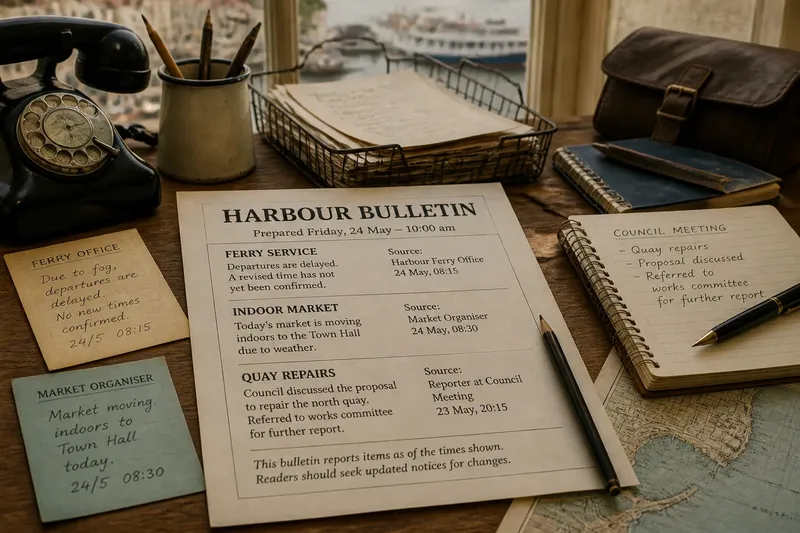
Printed bulletins gave readers a dated record of local events, not a live view of everything happening around them. A notice about a ferry interruption, a market move or a council decision could be useful precisely because the page showed what editors had confirmed before it went to press.
Printed bulletins recorded a moment in local life
Imagine a small harbour town where fog has disrupted ferry service, the market has moved indoors and a council meeting is considering quay repairs. An editor preparing a printed bulletin might receive a handwritten notice from the ferry office, a telephone message from the market organiser and a reporter’s notes from the meeting.
Each source offers a different kind of information. The ferry office can speak to its own service; the market organiser can confirm the venue; the reporter can describe what happened in the chamber. Treating each item according to what its source can actually know helps keep the bulletin’s claims within bounds.
The editor’s first task is therefore not simply to gather notices, but to establish what each one supports. A rumour about a cancelled crossing is not equivalent to a posted service notice. A proposal discussed by councillors is not an approved repair plan.
Dating an item helped readers judge its limits
A printed page could not change after distribution. If ferry arrangements shifted after the bulletin had gone to press, the copy in a reader’s hand remained as printed. A preparation time or date gave readers a basic clue about whether an update might have been overtaken by events.
That date did not make the information automatically complete or correct. It marked the point up to which the editor had assembled the account. For a changing service, readers might still need to consult the ferry office’s latest notice; for a council matter, they might look for the meeting’s confirmed decision rather than rely on an advance listing.
Think of a dated bulletin like a page in a diary: it preserves what was recorded at a particular moment, but it cannot write in later developments by itself.
Small wording choices could change the claim
Space on a printed sheet encouraged concise writing, but compression could blur important distinctions. “The ferry is cancelled” says something different from “the ferry is delayed”. “Council approves repairs” means something different from “councillors refer the proposal for further discussion”.
A careful editor would retain the detail that tells readers which claim is being made: the affected service, the confirmed change, or the actual outcome of the meeting. If a key fact remained unknown, the bulletin could say so rather than filling the gap with an assumption.
Say the harbour-town editor has a ferry notice stating that departures are delayed, but it gives no new timetable. The editor prints that service is delayed and that a revised time has not been confirmed; the observable result is a notice that informs travellers without implying a cancellation or inventing a schedule.
How should readers interpret a printed bulletin?
Who supplied each item?
Identify the named office, organiser or reporter behind a notice. Then consider whether that source is in a position to confirm the particular detail being reported.
When was the information prepared?
Look for a date, edition marking or stated preparation time. If the event can change quickly, treat an older printed notice as a record of what was known then and seek a current source before acting.
Does the wording separate a proposal from a decision?
Check whether the bulletin says an issue was discussed, referred, approved or rejected. If the wording stops short of a clear outcome, do not read a decision into it.
What important detail is still missing?
Notice whether the item leaves out a time, reason, location or next step that readers need to understand it. If that detail matters, seek the original notice or a fuller report rather than guessing.
Selection shaped the bulletin without making it a full record
An editor could not print every conversation, scrap of paper and passing rumour gathered during a day. Selection was unavoidable; the editorial responsibility was to leave out material without changing the sense of what remained. A short notice could direct readers to a longer report when the details needed more room.
The finished page offered a shared account with a clear boundary: these were the items gathered and checked for this edition. Its historical lesson is not that a compact format captures a whole community. It is that readers can judge a concise report more carefully when they ask who supplied the information, what the wording establishes and how old the account is.
When you encounter an old printed bulletin, preserve those clues as part of its meaning: the date, the source and the distinction between what was proposed and what was decided. They help turn a collection of notices into evidence of what readers could reasonably know at the time.